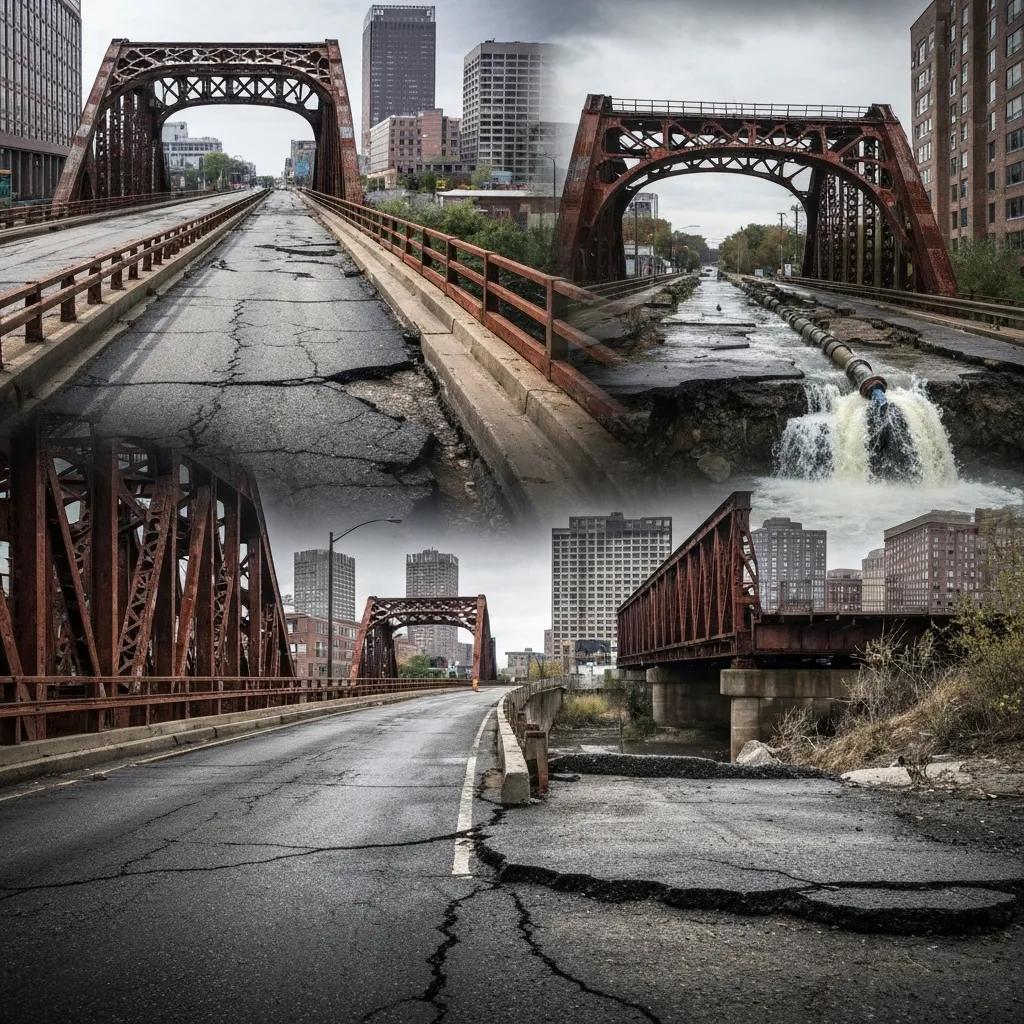
America’s Crumbling Infrastructure: Understanding the US Infrastructure Crisis and Solutions
Introduction
America’s infrastructure is deteriorating at alarming rates, posing risks to safety, the economy, and public health. This ticking time bomb beneath our feet demands urgent attention to roads, bridges, water systems, energy grids, and broadband networks. In this article, geonews.com—your trusted information hub—breaks down the current state of US infrastructure, examines water main breaks, analyzes bridge and road failures, explores how the Infrastructure Investment and Jobs Act (IIJA) addresses funding shortfalls, and reveals the broader economic and societal impacts. By the end, you’ll understand critical challenges and actionable pathways toward renewal.
What Is the Current State of America’s Infrastructure?
The American Society of Civil Engineers (ASCE) report card assigns US infrastructure a “C,” reflecting widespread deficiencies across five key sectors and signaling the need for immediate investment. Aging water mains, structurally deficient bridges, and congested roadways contribute to a growing public works crisis that wastes resources and undermines safety.
America’s Infrastructure Report Card
The American Society of Civil Engineers (ASCE) publishes a report card every four years, grading infrastructure sectors based on condition, capacity, funding, and resilience. The 2025 report assigned an overall grade of “C” to US infrastructure, the highest grade since 1998, reflecting the impact of recent investments.
This report provides an overview of the current state of US infrastructure, including roads, bridges, water systems, energy grids, and broadband networks, and highlights the need for investment.
How Does the American Infrastructure Report Card Reflect Infrastructure Conditions?
ASCE publishes a comprehensive report card every four years, grading each sector (roads, bridges, water, energy, broadband) based on condition, capacity, funding, and resilience. This grading mechanism highlights priority areas for federal, state, and local action, driving policy decisions that aim to close the funding gap and enhance system reliability.
Which Infrastructure Sectors Are Most Affected by Deterioration?
Roads, bridges, water systems, energy grids, and broadband networks each face unique challenges but share common issues: aging assets, underinvestment, and exposure to extreme weather. For example:
- Roads: 43% rated poor or mediocre
- Bridges: One in three structurally deficient
- Water: Six billion gallons lost daily from breaks
- Energy: Frequent outages due to grid strain
These multi-sector declines underscore the systemic nature of the crisis.
What Are the Main Causes of Infrastructure Decay?
Aging assets, insufficient maintenance budgets, deferred repairs, and climate-driven extreme events combine to accelerate deterioration. Underinvestment has created an estimated $2.6 trillion funding gap by 2029, while hotter temperatures and more intense storms further stress bridges and water mains, compounding economic losses.
Economic Impacts of Infrastructure Investment
The ASCE’s “Failure to Act” report series indicates that inadequate infrastructure investment will cost the US economy trillions of dollars in lost GDP and millions of jobs. The 2021 report estimated that the infrastructure investment gap would total over $2.6 trillion by 2029.
This report emphasizes the economic consequences of neglecting infrastructure, including reduced business productivity and increased costs for households.
What Are the Causes and Consequences of Water Main Breaks in the US?
Water main breaks occur every two minutes, resulting from combined factors that challenge public health and hinder water access.
What Factors Cause Water Main Breaks?
Water main breaks primarily stem from:
- Aging pipe materials (cast iron and unlined steel)
- Fluctuating pressure surges during peak demand
- Corrosive soil conditions and ground movement
- Climate-induced freeze-thaw cycles
These mechanisms weaken pipe walls, leading to leaks, service interruptions, and costly emergency repairs.
How Do Water Main Breaks Impact Public Health and the Environment?
Each break can introduce contaminants, trigger boil-water advisories, and waste six billion gallons of treated water daily. Beyond service disruptions, water loss increases treatment energy needs and elevates compliance costs under EPA water quality standards, affecting both municipalities and consumers.
What Solutions Exist for Aging Water Infrastructure?
Proactive strategies include targeted pipe replacement, advanced leak tracking using acoustic sensors, and storm-resilient materials. EPA initiatives under IIJA offer grant funding for modernization, while smart monitoring systems enable data-driven maintenance—reducing break rates and conserving resources.
How Does Failing Bridge and Road Infrastructure Affect the Economy and Safety?
Deteriorating transportation assets hamper commerce and endanger travelers, demanding robust funding solutions.
What Are the ASCE Grades and Statistics for Bridges and Roads?
ASCE’s 2025 grades assign a “C” to bridges and a “C-” to roads, with 46,000 bridges classified as structurally deficient and nearly half of public roadways in poor or mediocre condition. These grades quantify the scale of repair needs across 617,000 bridges and 4.12 million miles of highways.
How Do Infrastructure Failures Cause Economic Losses and Traffic Delays?
Congestion, detours, and emergency repairs contribute to $240 billion in annual productivity losses, equating to wasted fuel, lost time, and delayed deliveries that ripple through supply chains and inflate consumer costs.
What Funding Mechanisms Support Bridge and Road Repairs?
Federal, state, and local revenues—fueled by gas taxes and user fees—traditionally finance repairs. The IIJA introduces $110 billion for bridges and $350 billion for roads, supplemented by public-private partnerships that leverage private capital and risk-sharing models to accelerate project delivery.
| Sector | Funding Source | Allocation (2021–2026) |
|---|---|---|
| Bridges | IIJA Federal Grants | $110 billion |
| Roads | IIJA Highway Funds | $350 billion |
| Public-Private P3 | Toll concessions | Variable by state |
Combining these mechanisms restores structural integrity and improves travel efficiency.
How Is the Infrastructure Investment and Jobs Act (IIJA) Addressing the Funding Gap?
The IIJA allocates unprecedented resources to modernize critical systems, reducing America’s infrastructure deficit.
Infrastructure Investment and Jobs Act (IIJA)
The Infrastructure Investment and Jobs Act (IIJA), enacted in November 2021, authorizes $1.2 trillion for infrastructure spending, with $550 billion allocated to new investments and programs. This funding addresses various sectors, including water, broadband, and transportation.
The IIJA is a key piece of legislation aimed at modernizing critical systems and reducing the infrastructure deficit in the United States.
What Are the Key Provisions of the IIJA for Infrastructure Renewal?
IIJA provides $550 billion in new spending: $65 billion for water, $65 billion for broadband expansion, $73 billion for power grid resilience, and $110 billion for bridge repair. These provisions prioritize underserved communities and climate-resilient upgrades.
How Is IIJA Funding Allocated Across Infrastructure Projects?
Fund distribution hinges on federal grants, formula programs, and competitive awards:
- Bridge repairs via State DOT grants
- Broadband grants targeting rural and low-income areas
- Clean water projects through EPA’s Drinking Water State Revolving Fund
This allocation ensures targeted investment where needs are greatest.
What Role Do Public-Private Partnerships Play in Infrastructure Funding?
Public-private partnerships (P3s) blend public oversight with private capital, driving efficient project execution and lifecycle maintenance. P3 models reduce up-front taxpayer burdens and incentivize performance metrics, enabling faster delivery of highway widening, toll bridges, and energy grid upgrades.
What Are the Broader Economic and Societal Impacts of Infrastructure Failure?
Crumbling infrastructure imposes far-reaching economic, safety, and environmental costs that amplify national vulnerabilities.
How Does Infrastructure Decay Affect US GDP and Employment?
Deferred investment threatens $10 trillion in lost GDP by 2039 and jeopardizes 3 million jobs, as businesses face higher logistics expenses and reduced consumer spending from inefficiencies.
What Are the Public Safety and Supply Chain Risks?
Structural failures lead to bridge collapses, road hazards, and water contamination—endangering lives and prompting costly disaster recovery. Disrupted freight corridors hinder just-in-time delivery, straining manufacturing and retail sectors.
How Does Climate Change Exacerbate Infrastructure Vulnerabilities?
Extreme weather—floods, hurricanes, heatwaves—accelerates wear and triggers cascading failures in levees, transmission lines, and transportation networks. Integrating resilience measures, such as flood-tolerant materials and grid hardening, is essential to safeguard critical assets.
America stands at a crossroads: closing the infrastructure funding gap through strategic investment, innovative financing, and resilient design can transform a ticking time bomb into a springboard for sustainable growth. By harnessing comprehensive reporting and actionable insights from geonews.com, stakeholders can prioritize repairs, secure resources, and build a more robust foundation for future generations.
Frequently Asked Questions
What are the long-term economic consequences of neglecting infrastructure investment?
Neglecting infrastructure investment can lead to significant long-term economic consequences, including an estimated loss of $10 trillion in GDP by 2039. This decline is primarily due to increased logistics costs, reduced productivity, and diminished consumer spending. As infrastructure deteriorates, businesses face higher operational costs, which can lead to job losses and decreased economic growth. The ripple effects can strain public services and increase the burden on taxpayers, making it crucial to prioritize infrastructure funding to sustain economic stability.
How can communities advocate for better infrastructure funding?
Communities can advocate for better infrastructure funding by engaging in local government meetings, forming coalitions, and raising public awareness about infrastructure issues. They can also collaborate with advocacy groups to push for policy changes and funding allocations. Utilizing social media platforms to share information and mobilize support can amplify their voices. Additionally, communities can conduct surveys to gather data on local infrastructure needs, which can be presented to policymakers to demonstrate the urgency of investment in their areas.
What role does technology play in modernizing infrastructure?
Technology plays a crucial role in modernizing infrastructure by enabling smarter, more efficient systems. Innovations such as IoT sensors for real-time monitoring, data analytics for predictive maintenance, and advanced materials for construction enhance the resilience and longevity of infrastructure assets. Smart grids improve energy distribution, while digital platforms streamline project management and funding allocation. By integrating technology, infrastructure projects can be completed faster, with reduced costs and improved safety, ultimately leading to better service delivery for communities.
How does infrastructure investment impact climate change mitigation?
Infrastructure investment can significantly impact climate change mitigation by promoting sustainable practices and reducing greenhouse gas emissions. Investments in renewable energy sources, energy-efficient buildings, and public transportation systems can lower carbon footprints. Additionally, upgrading water and waste management systems can enhance resilience against climate-related events. By prioritizing green infrastructure, communities can not only address current deficiencies but also create systems that are better equipped to handle future climate challenges, fostering a more sustainable environment.
What are the benefits of public-private partnerships in infrastructure projects?
Public-private partnerships (P3s) offer several benefits for infrastructure projects, including access to private capital, which can alleviate the financial burden on taxpayers. P3s encourage innovation and efficiency, as private entities often bring expertise and advanced technologies to the table. They also enable faster project delivery through streamlined processes and shared risks. By leveraging the strengths of both sectors, P3s can enhance the quality and sustainability of infrastructure while ensuring accountability and performance standards are met.
How can individuals contribute to improving local infrastructure?
Individuals can contribute to improving local infrastructure by staying informed about community needs and participating in local governance. Volunteering for community boards or advocacy groups focused on infrastructure issues can amplify their impact. Additionally, residents can engage in public discussions, attend town hall meetings, and provide feedback on proposed projects. Supporting local initiatives and funding measures through petitions or campaigns can also help prioritize infrastructure improvements that benefit the community as a whole.
Conclusion
Addressing America’s infrastructure crisis is crucial for ensuring public safety, economic stability, and environmental sustainability. By understanding the challenges and solutions outlined, stakeholders can make informed decisions that lead to effective investments and repairs. We encourage you to explore further resources and engage with local initiatives aimed at revitalizing our infrastructure. Together, we can transform our aging systems into resilient networks that support future growth.